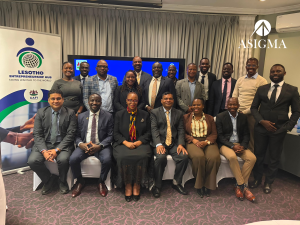
ASIGMA alongside other consortium partners convened a Programme Review Workshop to assess the cumulative performance of the Mastercard Foundation Micro and Small Enterprises (MSE) Recovery Fund, hosted by the lead partner Financial Sector Deepening Uganda.
As the initiative enters its fifth and final year of implementation, the review brought together key partners to reflect on delivery progress between 2022 and December 2025, evaluating alignment with the approved results framework, and to agree on priorities for the Fund’s final implementation phase.
The MSE Recovery Fund review and discussions underscored a shared commitment to consolidating impact, improving quality of outreach, and locking in sustainable access-to-finance models beyond the life of the Fund.
An Overview: Evidence-Led Performance Review
As of Q4 2025, cumulative disbursements to participating financial institutions (PFIs) had reached 126% of the approved deployment target – reflecting strong capital absorption, with systematic programme reporting enabling close tracking of fund utilisation and social impact delivery. Beneficiary outreach similarly exceeded key inclusion benchmarks, with women accounting for 64.7% of supported enterprises (against a 40% target) and youth representing 68.0% (against a 30% target).

Key Highlights: Taking Stock of MSE Recovery Fund Performance as the Programme Enters Final Year
1. Progress on Expanding Access to Finance
Objective 1: Extending access to finance for MSEs, the Fund continues to leverage both Tier III and Tier IV financial institutions to reach underserved enterprises. Tier III institutions have demonstrated depth and portfolio stability, while Tier IV institutions continue to present significant potential for scale, particularly in rural and informal markets.
The review reaffirmed persistent gaps in outreach to refugees and Persons with Disabilities (PWDs), as well as uneven regional distribution. While Central Uganda continues to lead in credit absorption, Northern and Eastern regions remain underrepresented, with Eastern Uganda’s performance concentrated in just two districts.
In response, ASIGMA has facilitated targeted capacity-building interventions for financial institutions in underserved regions and continues to manage the onboarding and post-capacity-building assessment of four institutions under the Affirmative Action initiative, aimed at accelerating inclusive outreach beyond original programme targets.
2. Sectoral Trends and Portfolio Quality
Wholesale and retail trade, alongside agriculture and agro-related activities, remain the leading sectors supported under the Fund, jointly accounting for approximately 80% of financed enterprises.
Partners agreed that the final year presents a critical opportunity to rebalance outreach, strengthen targeting, and prioritise quality over volume, ensuring that resources flow through the right channels to the most underserved segments.
3. Building Ecosystem Resilience Through Digitisation
Objective 2: Strengthening the resilience of the microfinance ecosystem, concerted efforts between partners to enforce support to Tier III and IV financial institutions continue through targeted digitisation and business model strengthening. The review reinforced that digital transformation must translate into operational efficiency, improved risk management, and institutional sustainability, rather than technology adoption alone.
Sustaining Impact Beyond the Fund
Looking ahead, the proposed final year phase will focus on impact consolidation, strengthened controls, and structured programme close-out.
As Facility Manager, ASIGMA reaffirmed its commitment to ensuring disciplined execution in the Fund’s final year, with a clear focus on embedding lasting access-to-finance models that endure beyond the programme lifecycle.
The review concluded with a shared emphasis by partners on moving beyond headline numbers to deliver inclusive, high-quality, and sustainable financial access, thus positioning the MSE Recovery Fund as a catalyst for long-term resilience within Uganda’s microfinance ecosystem.