Labour migration in Africa has become an increasingly important policy concern within the current geo-political environment. The International Labour Organisation (ILO) defines international labour migration as the movement of people across national borders for the purpose of employment encompassing legal as well as undocumented migration for work. The ILO estimates that there are over 169 million migrant workers globally. This presents a myriad of macro-economic opportunities and challenges to labour destinations and countries of origin.
Interestingly, migrant workers contribute to growth and development in their host countries, while their countries of origin also reap benefits in terms of remittances and skills acquired in their migration experience. On the other hand, labour migration undermines the demographic dividend of countries with youth majority populations as is the case in majority of the countries in Sub-Saharan African. In addition, labour migration exposes migrant workers to exploitation. Statistics from ILO show that on average, migrant workers earn 25% less than their counterparts and face triple the risk of forced labour.
According to the Mo Ibrahim Foundation, around 80% of African migrations are driven by the search for better economic prospects. Nigeria, Egypt, Ethiopia, and Kenya stand out as Africa’s leading sources of labour immigrants, exporting labour to Europe, North America, and the Gulf States with hundreds of thousands migrating annually in search of better employment opportunities, higher wages, and improved living conditions.
This article explores the systemic failures and labour inequalities in African economies, which drive international labour migration on the continent.
The Role of Labour Migration on Africa’s Economic Growth
Africa’s population in early 2025 is about 1.54 billion and is projected to reach around 1.8 billion by 2035, which is roughly a 17% increase over the next decade. The Institute for Security Studies (ISS) African Futures platform forecast shows that the African economy will expand by a healthy 4.5% from 2023 to 2043 compared to a 2.3% average for the rest of the world. However, because of rapid population growth, the 4.5% economic growth will translate into GDP per capita growth of only about 1.5% per annum in Africa, as shown in Illustration 1 below. With population growth outpacing GDP per capita, key economic indicators such as unemployment are expected to worsen, highlighting one of the key reasons for increased labour migration in Africa.
Illustration 1

Key Drivers of High Labour Migration in Africa
1. High unemployment rates
Countries such as Nigeria have youth unemployment rates of approximately 33% as of early 2025. Similarly, South Africa had an unemployment rate of 31.9% in the fourth quarter of 2024, with a total number of unemployed persons estimated to be 8 million of the country’s adult population. By 2030, over 30 million youth are expected to enter the African labour market each year. In Sub-Saharan Africa alone, while 18 million new jobs would be needed annually to absorb new entries in the labour market, only 3 million are currently being created.
2. Limited government intervention
High unemployment levels in the region, coupled with limited productive efforts by governments to curb the high levels of unemployment, also result in high labour migration rates across the continent. This is evidenced by the survey by the Mo Ibrahim Foundation that found around 80% of African migrations being driven by the search for better economic prospects.
Illustration 2
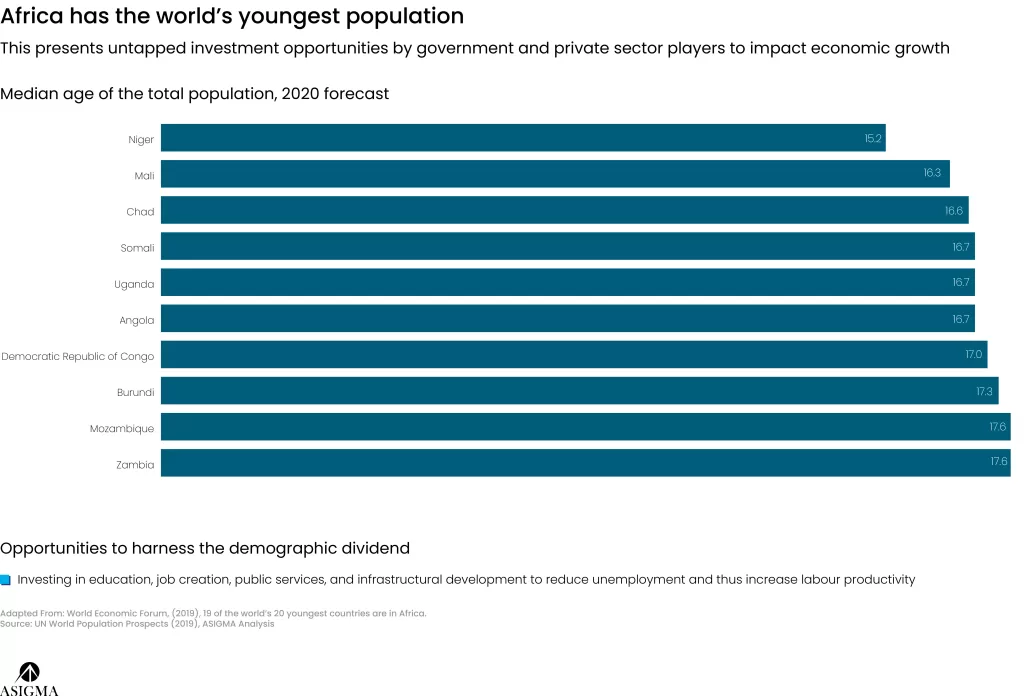
3. Heavy debt-burdens constraining public investment
Additionally, with many African governments being economically unstable and facing high debt-service burdens, there is minimal prioritization of investments into job creation, public services, and infrastructure. This further deepens economic hardship for citizens and incentivizes emigration. A 2025 study on Sub-Saharan Africa’s public debt found that over 20 countries on the continent spent more on debt repayments than on health and education combined in 2024. According to the World Bank, Sub-Saharan Africa will pay around $20 billion in interest on public and publicly guaranteed external debt in 2025. These interest payments will account for ~3.4% of the region’s combined GDP between 2025 and 2027. With such heavy debt-service obligations, African governments are not in a position to make investments that would result in job creation and better economic opportunities for their citizens. This further incentivizes labour migration, especially among the growing youth populations of countries such as Nigeria, Uganda, and Ghana among others.
4. Conflict and Instability
Beyond the poor job prospects faced by Africa’s growing youth population and uncertain economic environments within most African countries, a range of other factors further result in increased labour migration across the continent. These include persistent conflict and physical insecurity, which make certain parts of the continent difficult to thrive in for Africa’s young population. For example, South Sudan’s conflict that has lasted over 10 years has resulted in over 1.35 million youth leaving the country in search of better economic opportunities for improved livelihoods. According to the UN’s International Organization for Migration (IOM), new conflicts increased displacement in Sub-Saharan Africa where 9 million people were displaced in 2022 alone. In 2024, countries such as Mali earned themselves the top position in being the leading country of origin for irregular migration to Europe in 2024, with roughly 16,500 people migrating irregularly, reflecting conflict, repression, and deteriorating livelihood opportunities under the military junta. According to the Africa Center for Strategic Studies, conflicts in West Africa have led to migration of over 8 million people from Burkina Faso, 402,000 from Mali, and 112,000 from Guinea among others.
5. Career aspirations and professional ambitions
Apart from the above reasons that show necessity and survival as the key reason for Africa’s high levels of labour migration, research suggests that the migration of skilled Africans, particularly in health and STEM fields, is driven not only by economic necessity but by aspirations for career advancement, quality education, and professional fulfilment. This trend has intensified over the past two decades, with certain countries experiencing a critical loss of their most educated workforce, threatening the long-term development and resilience of their health and knowledge sectors. Between 2000 and 2011, the number of African doctors who migrated to OECD countries rose by one third to 55,541, while the number of nurses more than doubled to 135,970 in the same time period. According to OECD health statistics, data from 2019 showed that this trend continued beyond the early 2000s, and most of these doctors and nurses were originating from Nigeria, Egypt and South Africa.
Illustration 3
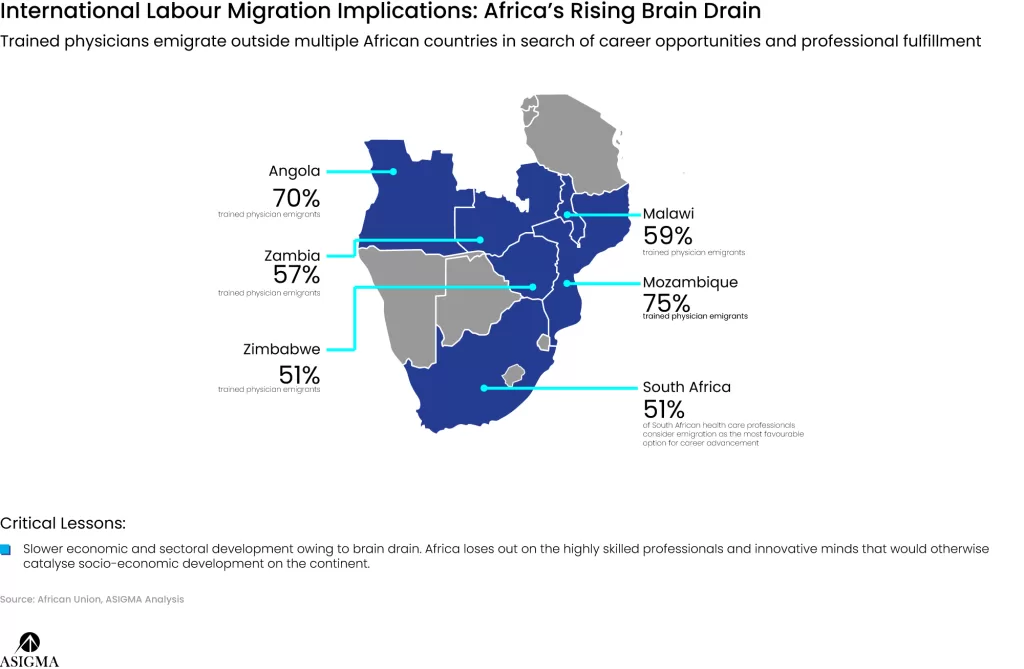
Beyond this, the availability of better education opportunities for high skill professions also contributes to the influx of African citizens going to Europe, the Middle East, Asia, and the United States, with no hopes of returning following the completion of their studies.
The Implications and Pitfalls on Africa’s Economy
Based on the above causes of high labour migration across Africa, the following section explores the implications and pitfalls of this migration.
Slower economic and sectoral development
One major implication of labour migration in Africa is slower economic and sectoral development owing to brain drain. Many of the individuals who are able to thrive professionally in Europe, the United States and Asia tend to be the among the top 10% of the continent’s talent pool. Consequently, Africa tends to miss out on highly skilled professionals and innovative minds that would otherwise catalyse socio-economic development on the continent. This is felt in terms of weakened institutional capacity, reduced innovation and inability to set up robust systems in service sectors such as healthcare, education, and technology. Additionally, brain drain not only limits innovation but also puts the continent’s populations at risk in cases where vital professionals (such as healthcare workers) are unwilling to build their careers on the continent. For example, a March 2025 article by Maryknoll revealed that since 2020, Zimbabwe has lost over 4,000 doctors to the UK’s National Health Service (NHS), primarily due to the attractiveness of wages earned in the UK. Similarly, In 2023, the UK issued nearly 350,000 Health and Care Worker visas, 23% (82,800) of which were issued to Nigerian healthcare professionals. In 2020, 13.7% of all doctors in Germany were migrants and around 8% of these were from Africa. The number of doctors from abroad has constantly been on the rise in Germany since the mid-1990s. These statistics demonstrate how professionals that are vital to maintaining African citizens’ quality of life are increasingly departing the continent in search of better opportunities, leaving key sectors of the economy understaffed.
Increased remittance dependency
The high labour migration also results in remittance dependency. Remittances into Africa serve as a significant source of income and a lifeline for families. According to RemitScope, remittance flows into Africa in 2023 amounted to approximately $90.2 Bn, with over 75% being used for consumptive purposes (including food, housing, school fees, etc) rather than productive purposes (such as investment in business working capital and productive assets). This trend results in a lack of innovation or incentive to think outside the box in a quest to create new solutions to pressing social and developmental issues on the continent.
Exploitation and Abusive working conditions
Workers departing the continent in search of better employment opportunities are often exposed to harsh working conditions and unfair practices resulting in exploitation and deteriorating mental health. According to the International Labour Organization, African migrant men in the Middle East that work in the construction sector reported working for an average of 70 hours, which is significantly higher than the standard working hours of 40 hours per week. Furthermore, a 2018 report by the African Regional Organisation of the International Trade Union Confederation (ITUC-AFRICA) revealed that many domestic migrant workers from Ghana, Uganda and Ethiopia are subjected to harsh working conditions and abuse of human rights including confiscation of passports, unpaid and underpaid wages, working for longer hours and sexual violence especially for women domestic migrant workers. These conditions often result in declining mental health, and sometimes in loss of life, further demonstrating the pitfalls of high labour migration.
Slipping Away of Africa’s Youth Dividend
Furthermore, countries with majority youthful populations risk missing out on the demographic dividend if their working age population continues to migrate in search of better employment prospects. The World Population Prospects for 2024 reports that for nearly three quarters of the counties with populations projected to peak between 2025 and 2054, the time-bound window of opportunity for accelerated economic growth associated with youth population has already closed.
Illustration 4

Strengthening Labour Migration Statistics in Africa: Policy and Practices to Explore
Therefore, for governments to curb the negative effects of labour migration in Africa, the following policy recommendations could play a significant role in reducing labour migration, while creating viable opportunities for the youth on the continent to build fulfilling and profitable livelihoods.
1. Making adjustments to bilateral labour agreements.
Governments should ensure that wages and working conditions are clearly set out and easily accessible to all affected individuals. This would reduce the prevalence of underpayment and exploitation in addition to introducing bans on actions like passport confiscations. Ensuring that these bilateral agreements also set out clear consequences for violation of the rules, and investing in enforcement (through tribunals to penalize non-compliant host nations) would go a long way in promoting safety and fair working conditions for African migrants working in various parts of the globe.
2. Investment in skills development to increase employability in local markets.
Government and other relevant stakeholders ought to make deliberate efforts to ensure appropriate skilling of the population to foster a more robust society, where individuals have the competencies needed to secure quality employment and are empowered to contribute meaningfully to the nation’s growth and development. Collaborative initiatives between training institutions, employers, and industry associations are required to ensure that training programs are demand-driven and aligned with market needs, thereby bridging the gap between the skills job seekers possess and those required by employers.
3. Role of private sector in addressing the high unemployment rates.
To address the high rates of high unemployment in Africa, governments should support private sector actors to create quality jobs, offer better working conditions and renumeration for employees, as well as provide opportunities for skills development and career growth that encourage professionals to remain and thrive on the continent.The government support could be in the form of favourable policies, tax incentives for businesses investing in local talents, and development of infrastructure to minimise the costs of business operations.
4. Implement incentive-based return and circular migration policies.
Designing incentive packages for diaspora returnees, including tax breaks, startup grants, and fast-track access to professional licensing, while avoiding creating tensions with local workers (by ensuring transparent eligibility criteria) would incentivize departed professionals to return home and contribute to local development, thereby reducing the negative impacts of brain drain on key sectors such as healthcare and technology.
5. Strengthen enforcement of “local content” policies.
African governments should place mandatory requirements on foreign investors to develop “local content”. This will create a positive shift in employment through job creation for Africans, and open equity to local partners as well as guaranteed investment in local supply chains. The resulting multiplier effect that would accrue from transfer of knowledge and value to the local economy and to indigenous companies should offset Africa’s labour outflows to a degree.
Conclusion
In conclusion, while labour migration in Africa is partly driven by economic necessity (due to unemployment and poor working conditions), it is also sometimes caused by a search for professional fulfilment and career advancement in the case of highly skilled professionals. This results in significant brain drain across the entire continent, creating spillover effects across various sectors of the economy. However, through the enactment of specific and targeted policy adjustments, labour migration and its negative impacts can be reduced by governments across the region.