The FinScope is a national survey that provides a comprehensive picture of how Rwandans access and use financial services
Rwanda is right at the cusp of universal financial inclusion. Rwanda’s Financial Services’ FinScope 2024 survey reveals that 96% of Rwandans adults are now financially included, a dramatic rise from just 48% in 2008. Even more impressively is the formal inclusion rate where adult using regulated financial services like banks, microfinance, mobile money, insurance, or pension has increased to 92% in 2024, surpassing the national target of 90% by 2024 as shown in Illustration 1.
This marks a major milestone for Rwanda’s development agenda. A key indication that the country’s efforts under the National Strategy for Transformation and Financial Sector Development Plan have paid off. But beyond the headline numbers, Rwanda’s Financial Services’ FinScope 2024 offers rich insights into how Rwandans are using financial services and where gaps remain.
In this article, we break down the key findings on inclusion trends, digital finance adoption, access to credit, saving behaviour, and emerging issues like climate risks and financial health. We also discuss what these findings mean for different stakeholders ranging from policymakers and banks to fintech innovators, development partners, and the country’s many micro, small and medium enterprises (MSMEs).
Nearly Universal Financial Inclusion – Leaving No One Behind
The 2024 FinScope survey confirms that Rwanda’s push for inclusive finance has truly reached the masses. Financial inclusion climbed to 96% in 2024 up from 93% in 2020. This is a reflection of the share of adults using formal or informal financial services. Such progress puts Rwanda within touching distance of its ambition for 100% inclusion, a rarity in the developing world.
The other interesting thing is the shift from informal to formal services. Back in 2020, 16% of adults relied only on informal mechanisms like community savings groups with no formal products. By 2024, that figure had plummeted to just 4%. In other words, almost everyone who was using informal finance has now been able to access formal financial services in some form. The expansion of mobile money, insurance, and pension schemes accounts for much of this shift.
Illustration 1
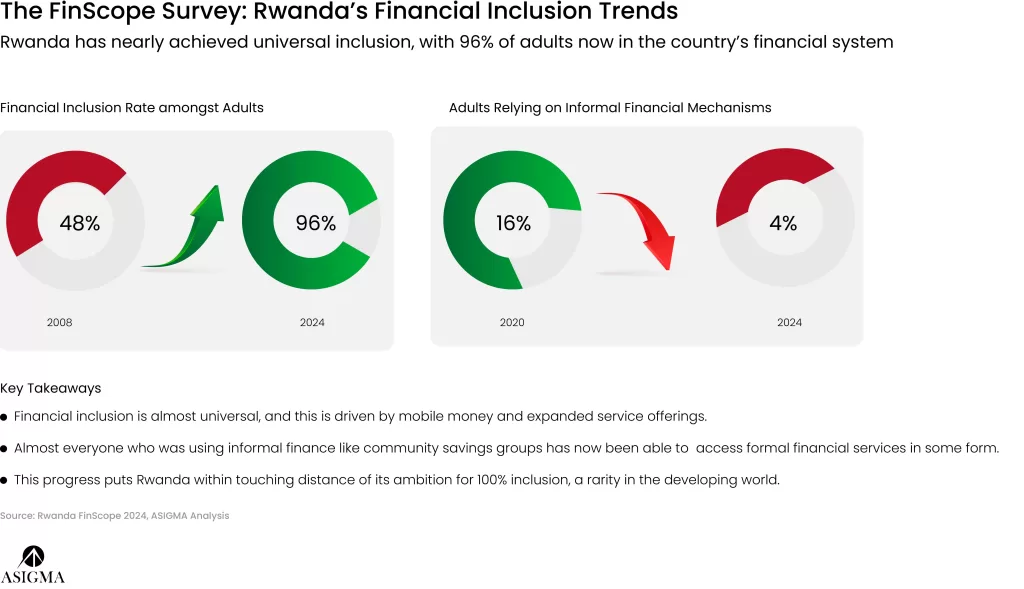
Formal inclusion jumped from 77% of adults in 2020 to 92% in 2024. This is an indicatoin that a significant portion of the Rwandans use regulated financial services
Who are the remaining excluded or underserved?
FinScope data show that the inclusion gender gap has virtually disappeared, shrinking to just a 1% difference between men and women in 2024. Women now participate in financial services at rates equal to men, a remarkable achievement compared to years past.
The urban-rural divide has likewise narrowed to about 1% essentially, rural residents are as financially included as city dwellers, thanks to widespread mobile money and the outreach of Savings and Credit Cooperatives (SACCOs) into rural communities. This broad-based inclusion extends to vulnerable groups as well. Notably, 93% of people living with disabilities are financially included, indicating efforts to make services accessible have had impact as shown in Illustration 2 below.
Illustration 2

Even refugees in Rwanda show a staggering 99% financial inclusion rate. Many refugees have been able to use mobile wallets or other non-bank services, in fact 36% of refugees have a bank account and 62% use other formal products, demonstrating Rwanda’s inclusive approach in refugee settlements.
These gains result from deliberate policies and innovations over the past decade. Initiatives like the rollout of one Umurenge SACCO in each sector of the country and the expansion of mobile financial services, have brought formal finance to the doorsteps of communities. According to FinScope, 77% of adults now have a transactional account which is either a bank account or mobile money wallet, up from 66% in 2020.
Rwanda Financial Services’ FinScope 2024 however finds that among those 23% of adults who still lack any transactional account, there is a concentration of certain profiles as illustrated below.
Illustration 3

These insights point to where stakeholders should focus next. Policymakers may need to bolster targeted outreach or subsidies for young people and smallholder farmers to get them onto the financial grid. Likewise, providers can design youth-friendly savings accounts or farmer credit products to pull these last pockets of exclusion into the formal system.
Digital Financial Services on the Rise and Rwanda’s Cashless Ambition
One of the most striking trends in FinScope 2024 is the explosive growth of digital financial service usage. Rwanda has been pursuing a “cashless economy” goal, and while cash is still common, the progress in digital payments adoption is undeniable. According to the survey, the share of adults who have performed digital financial transactions nearly tripled from 30% in 2020 to 73% in 2024. The steep rise in this metric reflects how quickly Rwandans have embraced tools like mobile wallets, payment apps, and other e-payment services.
Why the big jump? A combination of factors is at play. First, the COVID-19 pandemic likely accelerated digital uptake, FinScope reveals that about 16% of the population started using some form of digital finance for the first time during the pandemic period. Among these new users, mobile money was the entry point for 56%.
Secondly, mobile network operators and fintech companies have expanded their offerings, making digital payments more useful for daily needs. For example, mobile money services now go beyond simple P2P transfers. Rwandans can pay utility and tax bills, buy airtime, pay merchants via MoMoPay, receive bulk payments or salaries, and even get micro-loans and insurance via phone. Rwanda’s Financial Services’ FinScope 2024 notes that this expansion of use-cases, supported by the National Bank of Rwanda’s cashless strategy (RNPS 2018–2024), has led to greater uptake and habitual usage of digital finance.
That said, Rwanda hasn’t completely shaken off the dominance of cash in everyday commerce, not yet. The FinScope data reveals an interesting picture: while account ownership and digital capability are high, most Rwandans still receive and spend the bulk of their money in cash. For example, only 18% of adults report receiving their income digitally through a bank or mobile wallet, and the vast majority which are 76% get paid in cash.
When it comes to spending, 92% of Rwandans mainly use cash for common expenses. FinScope broke down some key use cases (see illustration 4 below):
- Almost 88% pay for food purchases in cash, and
- Expenses that are communication related such as airtime, data (65% cash), medical bills (45%), farming inputs (45%), and school fees (44%).
- Furthermore, utility bills which have digital payment options see only about one-third (34%) of people paying digitally, the rest still going for the cash payment option.
Illustration 4

The persistence of cash usage, despite widespread access to digital finance, underscores a critical challenge i.e., behavioural and institutional barriers. Many consumers simply trust cash for its tangibility, and merchants in rural markets are not yet fully equipped to accept digital payments for small purchases.
FinScope highlights that Rwandans “still prefer, or mainly use, cash” and calls for continued efforts to shift the mindset toward digital payments for efficiency, security, and user experience benefits. From a policy standpoint, this suggests that Rwanda’s cashless initiative needs to focus on increasing acceptance points and incentivising digital payments.
Although the government and financial sector have already taken steps such as promoting point-of-sale devices, QR code payments like MoMoPay, and cashless public transport payments, there is still significant room for growth. In particular, increasing the depth of digital usage by replacing cash wages with digital payrolls or retail cash payments with mobile money would further advance financial inclusion.
For fintech companies and innovators, these findings signal a ripe opportunity. With 86% of adults having used mobile money at least once, the digital rails are in place. The task now at hand is designing products that leverage this connectivity to solve everyday problems.
It’s worth noting that Rwanda’s journey to a cashless economy, while not complete, is ahead of many countries. The FinScope findings of a jump to 73% digital usage by 2024 are testament to deliberate strategic focus. The Rwanda National Payment Systems Strategy (2018–2024) laid out plans to increase electronic payments, and clearly those efforts have made an impact. These efforts include rolling out interoperable national switches, fostering mobile money innovations, and public awareness campaigns
As we move beyond 2024, stakeholders will likely double down to reach the next 27% of adults who have yet to meaningfully use digital finance, and to convert infrequent users into habitual users. The implication for policymakers and regulators is to continue supporting an enabling environment i.e., maintaining low transaction costs, ensuring reliable network coverage even in rural areas, and safeguarding consumer protection so that first-time users have positive experiences.
For banks and telecoms, interoperability and collaboration will be key, seamless integration between bank accounts and mobile wallets, for instance, can make it easier for people to transition between cash-in/out and digital holding of value. The FinScope data already show greater interoperability and innovation driving usage, so building on that success will be important.
Access to Credit: Formal Lending Rises as Fewer Rwandans Borrow Informally
Access to finance isn’t just about having an account, it’s also about the ability to obtain credit for investments, business, or to cope with emergencies. The FinScope survey 2024 paints an interesting picture of borrowing trends in Rwanda. On one hand, the use of formal credit such as loans from banks, microfinance institutions, SACCOs, or digital lenders increased. On the other hand, however, fewer people overall are borrowing money compared to four years ago.
63% of Rwandans adults reported borrowing money or taking goods on credit in the past 12 months, either from formal or informal sources. While that’s a majority of the population, it represents a significant decline from 2020, when 76% of adults were credit active. In other words, the credit-active population dropped by 13 percentage points. Consequently, the share of adults who did not borrow at all in the past year rose to 37%, an uprise from 24% in 2020.
This attributable to a post-pandemic normalisation where some households became more cautious about debt, or it might reflect improved incomes and savings reducing the need to borrow for daily needs. It also signals that certain informal credit channels became less accessible or less necessary for instance, during COVID lockdowns people might have borrowed informally to get by but later resumed earning. The data doesn’t fully explain the “why,” but the trend is clear, Rwandans are borrowing a bit less frequently than before.
Encouragingly, among those who do borrow, a larger fraction are using formal credit sources. FinScope’s Credit Strand analysis shows that formal credit uptake increased to 24% of adults in 2024, up from 22% in 2020.
Within formal credit, banks still play a relatively small role with only about 10% of adults borrowed from a bank in the last year. However, other formal lenders have become significant, reaching 19% of adults. These include:
- Umurenge SACCOs, which are serving about 5% of adults with loans,
- Microfinance institutions (serving 3%), and
- Digital/mobile credit products like MoKash (around 3% of adults took a mobile money loan).
The growth of SACCO lending is notable as community-based financial cooperatives, SACCOs often serve clients that banks consider too risky or remote. According to FinScope, 36% of adults use SACCOs in some capacity for savings or credit, up from 28% in 2020. These SACCOs particularly reach rural, farming, and informal segments that banks do not.
This suggests the SACCO network is a cornerstone of Rwanda’s formal credit expansion in rural areas. The slight uptick in digital loans via mobile money’s MoKash solution also shows fintech-based credit is emerging. Though still at low levels, accounting for 3% usage, many Rwandans remain cautious about borrowing via phone at high interest, or only small amounts are offered. Nonetheless, it points to future growth potential for fintech lending in a market where mobile wallets are ubiquitous.
While formal credit use rose, reliance on informal credit declined correspondingly. FinScope indicates that the proportion of adults who borrow exclusively from informal sources dropped from 49% in 2020 to 34% in 2024 as in illustration 5 below. This is a positive sign of financial system development. More people are able to tap regulated lenders instead of having to depend on moneylenders or only community sources.
Illustration 5

From a development perspective, the decline in overall borrowing could be interpreted in a few ways. It might reflect improved financial health, that is, people not needing to borrow for basic needs as much. Indeed, FinScope’s financial health metrics show some improvement, which could correlate with less distress borrowing. Alternatively, if fewer people borrowed because they lacked access or were discouraged due to credit constraints, which would be a concern. However, since formal lending actually increased, this suggests more that people chose not to borrow unless necessary, possibly a prudent shift in behaviour.
For MSMEs and small businesses, access to credit remains vital. Banks in Rwanda have traditionally been cautious, focusing on larger corporates or secured lending. The FinScope data depicts that only 10% MSMEs are getting bank loans which underscores that most entrepreneurs still rely on SACCOs, MFIs, or informal avenues for credit. High collateral requirements and credit history checks make bank loans out of reach for many micro-entrepreneurs. The growth of SACCO membership as well as the success of government credit programs like the Business Development Fund guarantees, may be slowly opening up financing for MSMEs. But clearly there is scope for financial institutions to do more in serving small business credit needs.
A Nation of Savers – Trends in Saving Behaviour
Rwandans have long been known for their saving culture, and the FinScope 2024 survey reaffirms that the vast majority of households save in some form. According to the data, 85% of adults save money whether formally, informally, or even just storing cash at home.
This is only a slight dip from 86% in 2020, indicating that the culture of saving remains robust. Saving can mean different things to different people: it ranges from depositing in a bank or mobile wallet, contributing to a community savings group, or simply tucking away cash under the mattress.
FinScope gives us a detailed look at where and how Rwandans are saving, and the trends are encouragingly toward safer, formal avenues.
Overall, 60% of Rwandans adults now save through formal mechanisms such as banks or non-bank formal services. This is huge increase from 48% in 2020, as in illustration 6 below.
Illustration 6
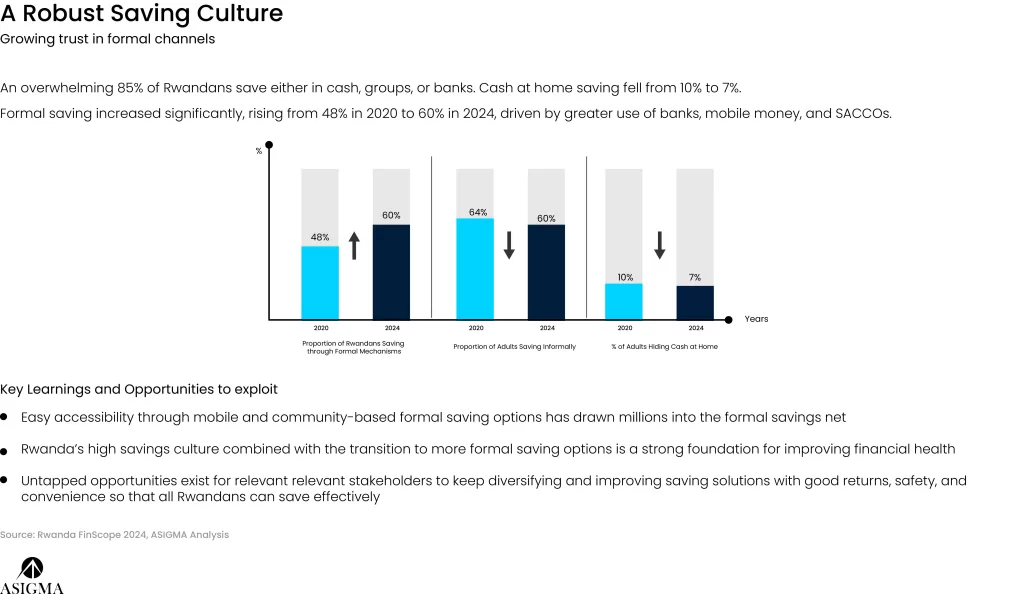
This means a majority of people entrust at least part of their savings to institutions or digital wallets rather than holding everything in cash. Within that, about 18% of adults report having savings at a commercial bank, while a much larger portion (55%) save via other formal channels like mobile money or Umurenge SACCOs.
The implication here is clear, mobile and community-based formal saving options have brought millions into the formal savings net. Many people find it easier to save in a mobile money account or with their local SACCO cooperative, as these are accessible and often require low minimum balances.
Meanwhile, informal saving remains prevalent at around 60% of adults as well, though down slightly from 64% in 2020. The most popular informal mechanism by far are saving groups i.e., small self-organised groups (like VSLAs, tontines, “ibimina”) where members pool money regularly and take turns borrowing. FinScope reports about 52% of Rwandans adults participate in savings groups. These groups are a cornerstone of community resilience and financial inclusion, especially for women. They not only promote saving discipline but also allow members to access lump sums of money through rotating payouts or loans from the group fund.
The slight decrease in informal saving could be attributed to some people shifting from saving in groups to saving in more formal ways especially as trust in banks and digital finance has grown. However, the fact that a majority still use these informal mechanisms shows they meet needs that formal institutions must continue to address like familiarity, social support and convenience.
One other notable shift is the decline in those who keep savings only at home in cash. In 2020, about 10% of adults solely saved by hiding cash at home. By 2024, this has reduced to 7%. This is a positive trend because money at home is vulnerable to theft, fire or impulsive spending and it doesn’t earn interest. The reduction suggests that some who used to distrust banks or had no access to other options have now moved into either informal groups or formal channels where their money is a bit safer or productive.
Rwanda’s high savings culture combined with the transition to more formal saving options is a strong foundation for improving financial health.
FinScope’s data on savings underscore a message which is, when suitable saving mechanisms are available, people use them. The task for the relevant stakeholders is to keep diversifying and improving these mechanisms with good returns, safety, and convenience. The aim should be for all Rwandans, rich or poor, to be able to save effectively towards their goals and for unexpected needs.
Building Resilience: Financial Health and Climate-Related Risks
FiFinancial inclusion isn’t an end in itself, since it serves as a powerful means to enhance household financial health and resilience. FinScope introduced an enhanced Financial Health framework to assess how well Rwandans are able to manage their day-to-day finances, cope with shocks, and plan for the future. The results show progress but also highlight that true financial security is still a work in progress for most families.
Additionally, 2024’s survey put a spotlight on climate-related financial risks, an emerging challenge that can quickly undermine the gains from inclusion if not addressed. Together, these aspects tell us about the well-being of the population beyond just access to services.
First, looking at financial health, FinScope created a framework based on four pillars:
- Ability to manage daily needs
- Ability to take advantage of opportunities
- Resilience to shocks
- Feeling in control of finances.
Adults were scored and categorised into four groups from financially healthy to financially vulnerable. The data reveals that as of 2024, only 10% of Rwandans adults are considered financially healthy. The majority, 57%, are “financially coping”, which implies they can manage decently but likely struggle in one or two areas or would fall into difficulty with a moderate shock. About 31% are financially vulnerable, and 3% are extremely financially vulnerable, basically on the brink of financial insecurity.
These figures as displayed in illustration 7 below might seem sobering, considering that, 90% are not fully healthy, but the context is that in 2020, the situation was worse. FinScope notes that a significant portion of adults improved their financial health since the last survey. Roughly 1.3 million people moved from financially vulnerable in 2020 to now being financially stable (either coping or healthy).
This improvement means more than two-thirds of adults can better balance income and expenses than before, are a bit more resilient, and can make sound financial decisions with greater confidence. It’s a positive trajectory, likely aided by the growing economy and the expansion of financial services, but it also underlines that only a small elite are truly secure. The vast majority are one job loss, failed harvest, or health emergency away from slipping backward.
One reason many households remain vulnerable is the prevalence of shocks and the limited use of insurance or other risk mitigation tools. Rwanda, like many countries, was hit hard by the COVID-19 pandemic and is increasingly feeling the impacts of climate change. FinScope 2024 gathered data on both. The COVID-19 impact was significant. About 66% of Rwandans said their livelihoods were negatively affected by the pandemic facing outcomes such as their incomes being reduced, businesses closed, or temporarily losing their jobs. This kind of systemic shock drained savings and forced many to deplete resources or borrow.
In terms of climate-related shocks, the survey finds that a staggering 69% of adults have experienced a climate change-related event impacting their household. Rwanda’s hilly terrain and rain-fed agriculture make it vulnerable to weather extremes.
The most common events reported were:
- Heavy rains and floods affecting 56% of the population,
- Droughts or water scarcity affecting 25%,
- Storms affecting 21% and
- Pest infestations affecting 27%, which devastates crops.
Illustration 7

Over half (53%) of those hit by climate events said they’ve been impacted repeatedly, not just a one-off. These shocks can destroy homes, reduce harvests, kill livestock, and generally erode a family’s financial base thus pushing people into poverty or preventing them from advancing.
This worryingly indicates that most Rwandans are underprepared for such shocks. Among those who experienced climate-related events, only 30% took or had measures to mitigate the financial impact. That means 70% basically absorbed the loss with no buffer or solution, highlighting a huge vulnerability.
When asked how they would cope with future climate shocks:
- The most common answer by 33% of the respondents was “wait for government assistance”.
- This was followed by 18% who said they would have to deplete their own savings.
- Smaller proportions mentioned strategies like selling livestock or assets, cutting expenses, borrowing from friends/family, or taking a loan.
- Very few indicated having insurance indicating that an insurance policy was near the bottom of the list of coping strategies. This underscores an important gap i.e., insurance penetration remains low despite these risk.
Implications and Calls to Action for Different Relevant Stakeholders
Policymakers & Regulators
- Reducing the financial inclusion gaps through mandates and incentivisation of universal digital payments to deepen quality usage and fold in the last 8% of unbanked adults.
Banks and Financial Institutions
- Navigate partnerships and co‑create low‑cost, simplified, mobile‑first banking and lending solutions. These can be explored in conjunction with SACCOs and fintechs, to serve mass‑market and MSME segments.
Development Partners and Donors
- Provide catalytic risk‑sharing facilities and digital capacity building to extend formal finance deeper into underserved segments. This can be explored through for SACCOs and Micro Finance Institutions (MFIs) to unlock lending to youth, smallholders, and micro‑enterprises.
MSMEs and Entrepreneurs
- Harness digital‑payments networks and emerging financial instruments to build transparent revenue records and unlock formal credit for growth.
Conclusion
Rwanda’s financial inclusion journey is a story of remarkable success with an eye on the next challenges. Rwanda’s Financial Services’ FinScope 2024 survey shows that the country has built an inclusive financial ecosystem that leaves no demographic group significantly behind. This is an established foundation that many developing nations aspire to. The task now is to leverage that foundation to drive economic empowerment and resilience.
By shifting focus from access to usage and value, stakeholders can ensure that having a bank account or mobile wallet translates into tangible improvements in people’s lives. This can either be a small business getting the capital it needs to expand, a family cushioning itself from a bad harvest, or a young person budgeting and saving for a better future. Rwanda’s vision of a cashless, financially secure society is within reach if all these actors play their part. The data and trends from FinScope 2024 will help guide strategies, but it will be the collaboration and commitment on the ground that ultimately turn these insights into impact.
In closing, Rwanda’s experience underscores a broader lesson in financial inclusion: success is not just about numbers, but about narratives. The narrative here is moving from one of basic inclusion to one of empowerment where every Rwandans not only has a financial account but can use it to achieve their goals and withstand setbacks. It’s a journey that will continue, and one that will be closely watched as a model for Africa and beyond.